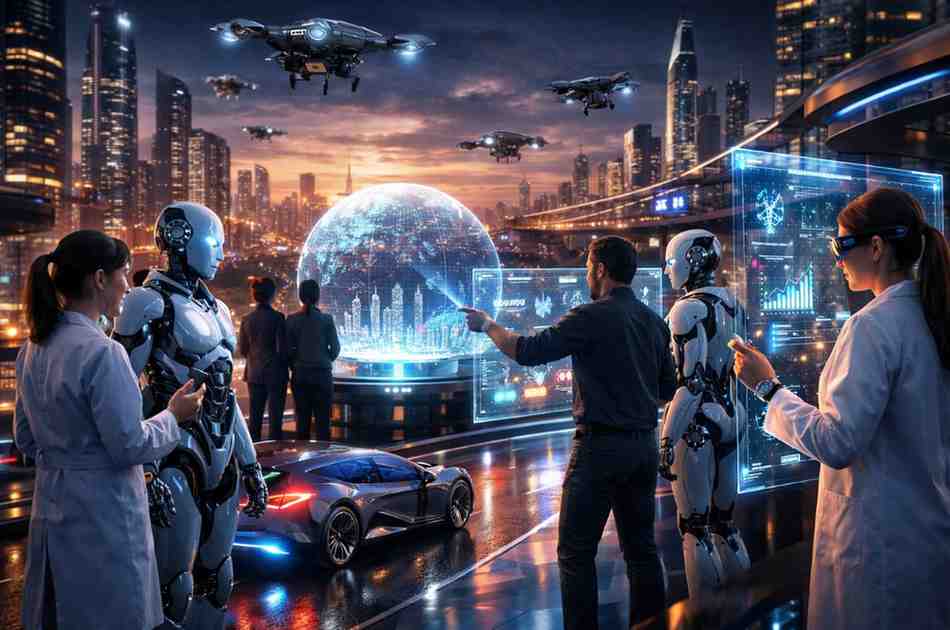
We live in a world where technology evolves faster than most of us can keep up with. Every year, innovations emerge that promise to reshape the way we live, work, and interact with the world around us. From artificial intelligence to quantum computing, these emerging and future technologies are not just concepts—they are rapidly becoming integral parts of our daily lives.
Understanding these technologies is key to preparing for a future where automation, connectivity, and intelligence dominate every aspect of society. In this blog, we explore the most promising emerging technologies, their applications, and the transformative potential they carry.
1. Artificial Intelligence (AI) and Machine Learning
AI is no longer just a futuristic idea—it’s already embedded in our smartphones, healthcare systems, and businesses. Machine learning, a subset of AI, enables systems to learn from data, identify patterns, and make decisions without explicit programming.
Key Applications:
- Healthcare: AI assists in diagnostics, predictive analysis, and personalized treatment plans.
- Autonomous Vehicles: Self-driving cars rely heavily on AI for navigation and safety.
- Business: AI enhances customer service through chatbots and optimizes supply chains.
- Creative Industries: AI-generated content, music, and art are redefining creative work.
Future Potential: AI may evolve into Artificial General Intelligence (AGI)—machines capable of reasoning, learning, and solving problems across domains just like humans. This could revolutionize industries, but it also raises ethical questions about employment, privacy, and control.
2. Quantum Computing
Quantum computing leverages the principles of quantum mechanics to process information far faster than classical computers. Unlike traditional binary systems (0s and 1s), quantum computers use qubits, which can exist in multiple states simultaneously, allowing unprecedented computational power.
Key Applications:
- Drug Discovery: Simulating molecular interactions that would take classical computers years.
- Cryptography: Quantum computers could break traditional encryption, prompting a new era of quantum-safe security.
- Optimization Problems: From logistics to financial modeling, quantum computing can find optimal solutions quickly.
Future Potential: Once scalable and commercially viable, quantum computers could revolutionize medicine, climate modeling, artificial intelligence, and materials science.
3. Biotechnology and Genetic Engineering
Biotechnology is advancing rapidly, driven by breakthroughs in CRISPR gene-editing, synthetic biology, and regenerative medicine. These technologies have the potential to treat diseases, enhance human capabilities, and even extend life expectancy.
Key Applications:
- Gene Therapy: Correcting genetic disorders like sickle cell anemia or muscular dystrophy.
- Agriculture: Creating crops that are drought-resistant or nutrient-rich.
- Synthetic Biology: Engineering microbes to produce biofuels or pharmaceuticals.
Future Potential: Biotechnology could reshape healthcare and agriculture completely, potentially leading to personalized medicine and even designer organisms. Ethical debates will intensify as these technologies advance.
4. Internet of Things (IoT) and Smart Connectivity
The Internet of Things refers to interconnected devices that collect and exchange data. From smart homes to industrial sensors, IoT is making our environment more responsive and data-driven.
Key Applications:
- Smart Cities: Optimizing traffic, energy use, and public safety.
- Healthcare: Wearables monitor vital signs and predict potential health issues.
- Industry 4.0: Connected machinery improves efficiency and predictive maintenance.
Future Potential: IoT could evolve into a fully connected world, where almost every object is a sensor feeding into intelligent systems. This raises both opportunities in convenience and challenges in privacy and cybersecurity.
5. Renewable Energy and Sustainable Technologies
As climate change becomes an urgent global issue, emerging renewable technologies are transforming how we generate and use energy.
Key Innovations:
- Solar and Wind: Cheaper, more efficient solar panels and offshore wind farms.
- Energy Storage: Advanced batteries and supercapacitors improve grid reliability.
- Green Hydrogen: A clean alternative to fossil fuels for heavy industry and transport.
Future Potential: The convergence of AI, smart grids, and renewable energy could create sustainable, self-optimizing energy systems, reducing humanity’s carbon footprint dramatically.
6. Extended Reality (XR): AR, VR, and MR
Extended reality encompasses Augmented Reality (AR), Virtual Reality (VR), and Mixed Reality (MR). These immersive technologies are transforming entertainment, education, and professional training.
Key Applications:
- Education: VR simulations allow hands-on training in medicine, engineering, and aviation.
- Gaming & Entertainment: AR and VR provide immersive experiences.
- Remote Collaboration: Virtual workspaces improve communication for global teams.
Future Potential: XR could redefine how we interact with information and people, creating virtual worlds as integral to daily life as the internet is today.
7. Robotics and Automation
Robotics, powered by AI and IoT, is changing manufacturing, logistics, healthcare, and even domestic life.
Key Applications:
- Surgical Robots: Increasing precision in complex surgeries.
- Autonomous Drones: Delivering packages and performing surveillance.
- Industrial Automation: Reducing human labor in repetitive or hazardous tasks.
Future Potential: Fully autonomous, intelligent robots may become collaborative partners in work and life, raising questions about employment, ethics, and safety.
8. Space Technologies and Exploration
The final frontier is now increasingly accessible thanks to private companies like SpaceX, Blue Origin, and national space programs.
Key Applications:
- Satellite Internet: Global connectivity through networks like Starlink.
- Space Mining: Extracting rare minerals from asteroids.
- Interplanetary Travel: Mars missions and lunar bases.
Future Potential: Space technologies may transform economies, communication, and even humanity’s survival as a multi-planetary species.
The Convergence of Emerging Technologies
What makes these technologies particularly exciting is their convergence. AI powers robotics, quantum computing accelerates biotechnology, and IoT integrates with renewable energy for smart grids. The result is an exponential acceleration in innovation, where breakthroughs in one field amplify possibilities in another.
Challenges and Ethical Considerations
- Privacy and Security: IoT and AI can enable surveillance and data breaches.
- Job Displacement: Automation may replace millions of jobs, requiring reskilling.
- Ethical Dilemmas: Genetic editing, AI decision-making, and autonomous weapons pose moral questions.
- Environmental Impact: Tech manufacturing and e-waste must be managed responsibly.
Balancing innovation with ethical responsibility will define how successfully humanity leverages these technologies.
Conclusion
Emerging and future technologies are reshaping our world at an unprecedented pace. From AI and quantum computing to biotechnology and space exploration, the possibilities are staggering. These technologies promise to improve quality of life, expand knowledge, and open new frontiers, but they also demand careful ethical, social, and environmental consideration.
The future is no longer distant—it’s unfolding today. Understanding and engaging with these technologies will not only prepare us for what’s to come but allow us to actively shape the world we want to live in.