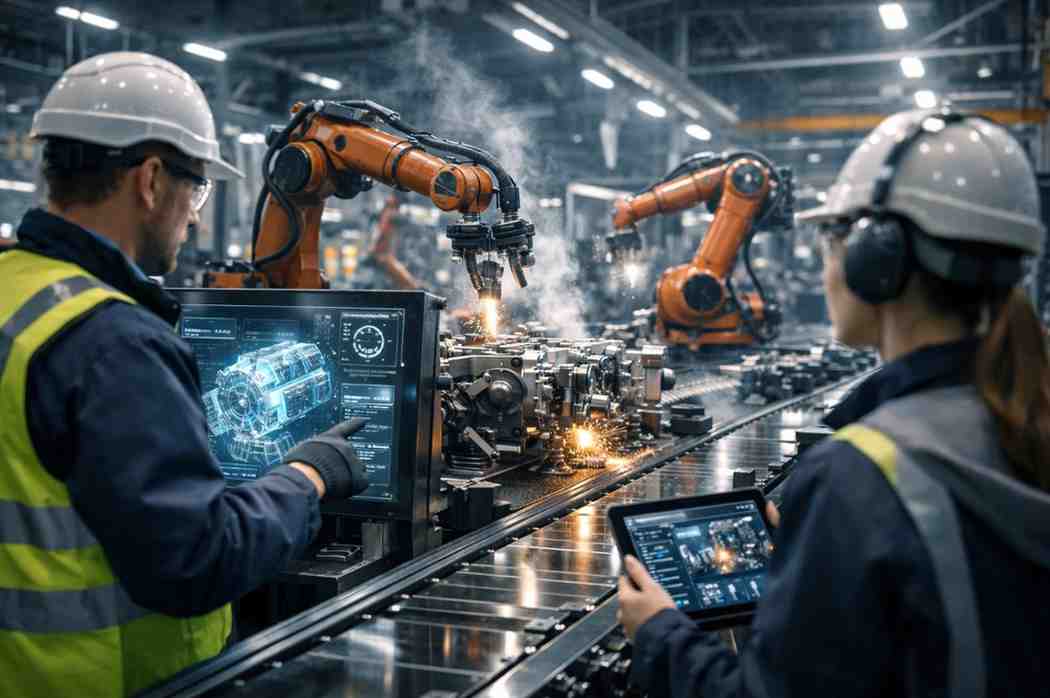
Industrial and manufacturing technology has been the backbone of human civilization for centuries, evolving from the steam engines of the Industrial Revolution to today’s smart factories and automated production lines. As industries face growing global demand, competition, and sustainability challenges, technology continues to transform the way goods are designed, produced, and delivered.
From traditional manufacturing methods to cutting-edge innovations like robotics, 3D printing, and AI-driven systems, industrial technology is at the heart of modern economies. This blog explores the key trends, applications, and future potential of industrial and manufacturing technology.
The Evolution of Industrial & Manufacturing Technology
Historically, manufacturing technology has progressed in distinct industrial revolutions:
- First Industrial Revolution (18th–19th Century): Introduction of steam engines and mechanized production.
- Second Industrial Revolution (Late 19th–Early 20th Century): Mass production, assembly lines, and electricity-powered factories.
- Third Industrial Revolution (Late 20th Century): Automation, computers, and robotics revolutionized production.
- Fourth Industrial Revolution (Industry 4.0): Integration of digital technologies, IoT, AI, and smart manufacturing.
Today, we are entering a phase often called Industry 5.0, which emphasizes collaboration between humans and machines, sustainability, and advanced customization.
Key Industrial & Manufacturing Technologies
1. Automation and Robotics
Automation is no longer limited to repetitive tasks on factory floors. Advanced robotics now handle complex assembly, quality control, and logistics.
- Automotive assembly lines
- Electronics manufacturing and testing
- Packaging, material handling, and warehouse automation
Future Potential: Collaborative robots (cobots) will work alongside humans, enhancing productivity while reducing workplace hazards.
2. Additive Manufacturing (3D Printing)
3D printing allows manufacturers to create objects layer by layer, enabling rapid prototyping, customization, and reduced material waste.
- Aerospace and automotive parts production
- Medical devices and prosthetics
- Consumer products with personalized designs
Future Potential: Large-scale additive manufacturing could revolutionize supply chains by reducing inventory needs and enabling on-demand production.
3. Internet of Things (IoT) in Manufacturing
IoT connects machines, sensors, and devices to collect and analyze data in real-time, enabling smart factories.
- Predictive maintenance of equipment
- Real-time production monitoring
- Optimizing energy consumption and operational efficiency
Future Potential: Fully integrated IoT systems could create self-optimizing factories, improving quality, reducing downtime, and minimizing waste.
4. Artificial Intelligence (AI) and Machine Learning
AI is increasingly shaping industrial operations by providing insights from massive datasets, optimizing production, and improving quality control.
- Predicting equipment failures before they occur
- Optimizing supply chain management
- Enhancing product design through simulation and modeling
Future Potential: AI could enable autonomous factories, where machines make real-time decisions with minimal human intervention.
5. Advanced Materials and Nanotechnology
Innovations in materials science are enabling stronger, lighter, and more sustainable products. Nanotechnology is being used to enhance durability, efficiency, and energy performance.
- Lightweight composites in aerospace and automotive industries
- Anti-corrosive and self-healing coatings
- Energy-efficient electronics and batteries
Future Potential: These materials could reshape product design, allowing previously impossible applications and more sustainable manufacturing practices.
6. Digital Twins and Simulation
A digital twin is a virtual replica of a physical system, allowing manufacturers to simulate operations, predict failures, and optimize processes.
- Simulating assembly line workflows
- Testing machinery performance under various conditions
- Reducing downtime through virtual troubleshooting
Future Potential: Digital twins may become standard for all large-scale industrial operations, enabling real-time monitoring and global collaboration.
7. Sustainable and Green Manufacturing
Modern industrial technology increasingly focuses on environmental sustainability. Factories are adopting cleaner energy, waste reduction, and circular economy principles.
- Energy-efficient machinery
- Recycling and reuse of industrial waste
- Eco-friendly production processes using renewable resources
Future Potential: Sustainable manufacturing could reduce the global carbon footprint and transform supply chains to be both economically and environmentally efficient.
The Convergence of Technologies
Industrial and manufacturing technology is not about isolated innovations—it’s about integration. For example:
- AI + IoT = smart predictive maintenance
- 3D printing + advanced materials = custom lightweight parts
- Robotics + digital twins = real-time optimization and error correction
This convergence is creating highly efficient, flexible, and resilient manufacturing ecosystems capable of responding to global challenges and market demands.
Challenges in Modern Manufacturing
- Cybersecurity: Connected factories are vulnerable to hacking.
- Workforce Transition: Automation may displace some jobs, requiring reskilling.
- High Initial Costs: Advanced technology investments can be expensive.
- Sustainability Trade-offs: Some new technologies still have significant environmental footprints.
Balancing innovation, cost, and social responsibility is key to maximizing the benefits of industrial technology.
Conclusion
Industrial and manufacturing technology is the engine of modern economies, driving productivity, efficiency, and innovation. From smart factories and AI-powered automation to 3D printing and sustainable production, the future of manufacturing promises customized, efficient, and environmentally conscious production.
As these technologies converge, they will transform industries, redefine jobs, and reshape how products are designed and delivered. The factories of the future are intelligent, connected, and collaborative, marking a new era of industrial excellence.